An email address that carries your own name

Something like [email protected] is yours to set up. This site explains it in plain words, one step at a time.

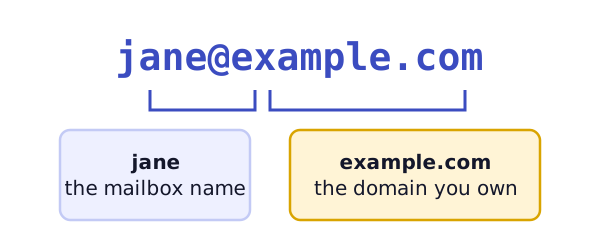
An address points to a mailbox, the place where your messages are delivered.[1]
Start with the basics → New

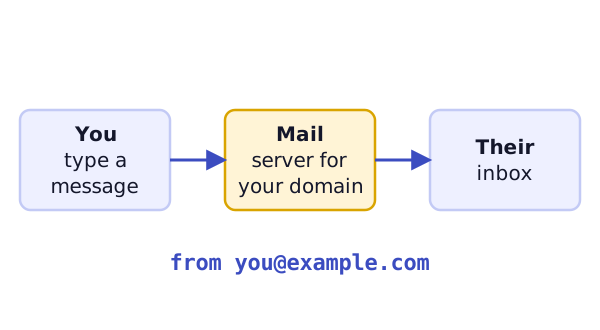
You type a message, it goes to the mail server for your domain, then to their inbox. Below, the sender address you@example.com.
Mail from your own address passes through your domain's mail server.

Three words you'll meet first

  1. 1
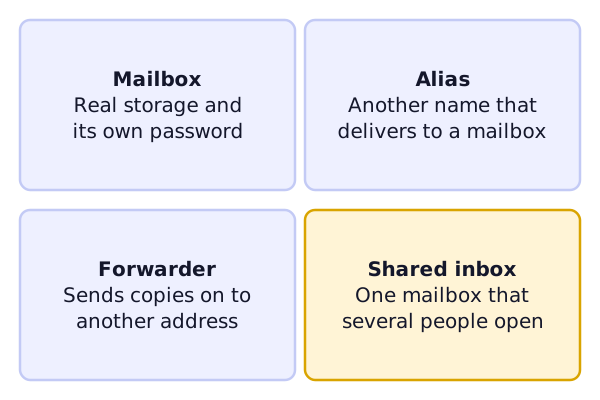
    Four boxes in a grid. Mailbox: real storage and its own password. Alias: another name that delivers to a mailbox. Forwarder: sends copies on to another address. Shared inbox: one mailbox that several people open.
    The four kinds of address you will meet.

    Mailbox

    Where your messages are kept. It has its own password.
  2. 2
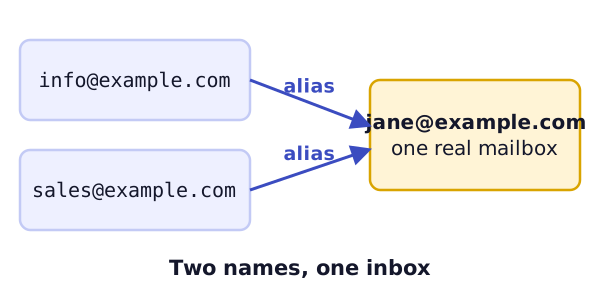
    Two addresses, info@example.com and sales@example.com, each with an arrow labelled alias pointing to one real mailbox, jane@example.com. The caption reads two names, one inbox.
    Two alias names can lead to one mailbox.

    Alias

    A second name that delivers to a mailbox you already have.
  3. 3
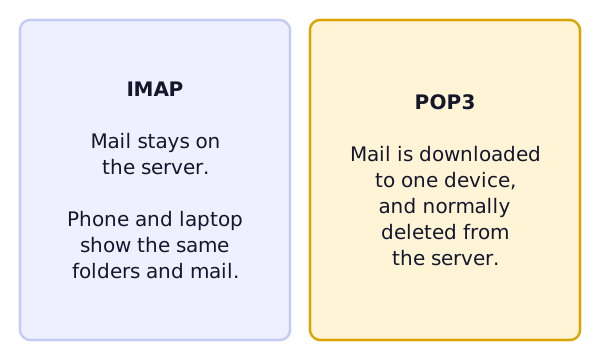
    Two boxes. IMAP: mail stays on the server, and phone and laptop show the same folders and mail. POP3: mail is downloaded to one device and normally deleted from the server.
    IMAP keeps mail on the server. POP3 normally downloads it.

    IMAP

    A way for apps to read mail that stays on the server.[2]

Pick a job

Quick answers

What does SMTP do?

It carries your outgoing mail. Its aim is to transfer mail reliably and efficiently.[3]

Do I have to use an app?

No. You can read mail in a web browser too.

Which page should I read first?

The one on why use email at your own domain.

How this site works

  • Every guide page lists its sources at the bottom.
  • The pictures are drawn for this site.
  • There are no ads, affiliate links or sponsors.

Sources

  1. Email address, Wikipedia (accessed 2026-11-03)
  2. RFC 3501: Internet Message Access Protocol - Version 4rev1, IETF (accessed 2026-11-03)
  3. RFC 5321: Simple Mail Transfer Protocol, IETF (accessed 2026-11-03)